Building the Machine Layer
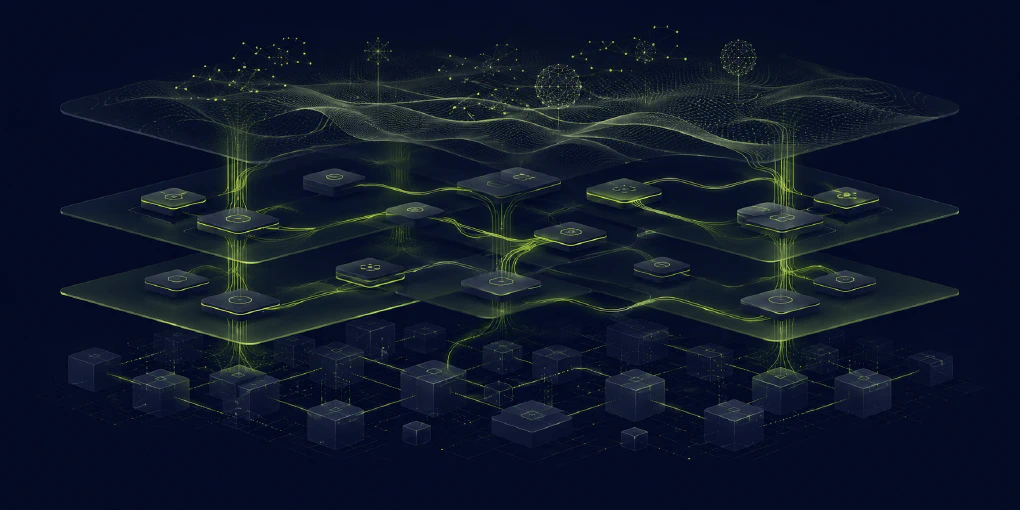
The next generation of companies will be API-native — services consumed and composed at any granularity, where humans, applications, and autonomous agents transact equally. The execution settles on blockchain rails, invisible to the end user. We call this the Machine Layer.
We advise, architect and build at this convergence — where intelligence, identity, attestations, and revenue streams become programmable infrastructure.
Start a conversationThe Machine Layer
The API economy with economics built into the protocol.
The API Economy, Rebuilt
In 2015, the API economy meant REST endpoints behind API gateways, billed monthly through Stripe at 2.9% + $0.30. That economic floor meant only coarse-grained services could be monetized.
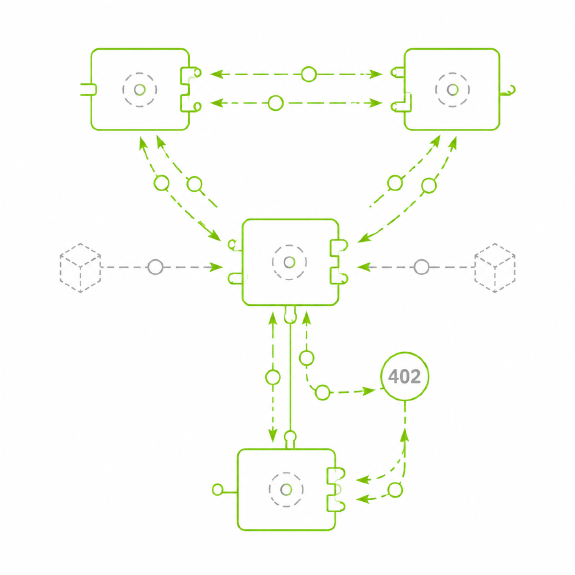
The revolution isn’t autonomous agents — just as the car industry revolution isn’t autonomous driving. It’s the re-architecture of the stack. x402 turns HTTP’s forgotten “402 Payment Required” into a real-time settlement protocol. MPP enables streaming micropayments at sub-cent granularity. Every capability becomes a priced, composable endpoint — consumed by humans, apps, or machines indifferently.
This is the API Economy rebuilt with economics at the protocol layer, not bolted on after.
Blockchain as Settlement Infrastructure
Stablecoin rails are becoming the execution layer for programmable commerce. Institutional adoption is accelerating behind the scenes — not for speculation, but for settlement.
What matters isn’t throughput. It’s what the rails enable: composable authorization (ERC-8183 — cascading delegation with revocation), machine-readable reputation (ERC-8004 — attestations that accrue with every transaction), and atomic settlement of micro-value at the protocol level.
x402 and MPP don’t just use blockchain. They make blockchain useful for business — turning settlement infrastructure into a programmable economic layer that API-native companies build on directly.
Trust and Privacy by Construction
Machine-speed transactions require machine-verifiable trust. On-chain attestations (ERC-8004) let any service prove its track record — reputation that accrues with every transaction, without a central authority vouching for it. Delegated authorization (ERC-8183) governs what agents can spend, with cascading limits and instant revocation.
Trust also requires privacy. Every granular API call on a public blockchain is a data point — attributable, traceable, leaking competitive information. Nansen and Chainalysis already map wallets to corporate entities. Pseudonymity alone is not enough.
Zero-knowledge proofs solve this structurally: prove authorization, prove reputation, prove compliance — without revealing who, how much, or how often. Privacy isn’t a feature. It’s the prerequisite that makes everything else enterprise-adoptable.
Capabilities
Three convergent domains — AI and Web3 as enablers, agentic transactions as the destination.
AI & Autonomous Systems
Large language models, autonomous agents, and process intelligence are transforming how organizations operate. We architect systems where AI moves from advisory to autonomous — agents that reason, act, and learn within defined boundaries.
- Autonomous agent architecture (MCP, multi-agent systems)
- Process intelligence and optimization
- LLM integration and enterprise AI strategy
- From predictive analytics to prescriptive autonomous action

Web3 & Zero-Knowledge
Blockchain provides the trust, identity, and payment rails that autonomous systems need to operate safely. Zero-knowledge proofs add privacy-preserving verification — proving facts without revealing underlying data.
- Smart contract architecture (Ethereum, Solana, SUI)
- ZK proofs for identity and compliance (Circom, Noir)
- On-chain reputation and attestation (ERC-8004)
- Tokenization and verifiable computation

Agentic Transactions
The convergence point: autonomous systems that transact. x402 enables HTTP-native micropayments. ERC-8183 governs delegated spending with cascading authorization and revocation. Together, they unlock agent commerce at enterprise scale.
- x402 protocol — the internet’s missing payment layer
- ERC-8183 — delegated spending and agent authorization
- Agent commerce infrastructure (identity, memory, reputation)
- API-first business model architecture
Selected Work
Strategy claims are easier to believe when something was actually built.
DeFi Strategy Infrastructure
A DeFi vault and investment strategy on Arbitrum in Solidity, plus an indexing, analytics and reporting backend for analyzing, backtesting and simulating strategies.
x402commit
Infrastructure to tokenize the future cashflow of a paid API or agent — issuing shares in the revenue stream rather than in the company, settled on x402 with ERC-8004 attestations.
Detox Hook
A Uniswap v4 Hook that captures arbitrage profit using Pyth real-time prices and donates the value back to LPs, while leaving organic flow unaffected. Deployed on Arbitrum Sepolia with dynamic fee and value-donation mechanics.
Perspectives
Opinions on where the machine economy is heading — and what it takes to build there.
How We Engage
We work lean, with domain specialists assembled per engagement. Work can end with a decision, a validated prototype, or an operational system — depending on the problem and the capabilities already in your team.
Advise
- Board and executive technology advisory
- Opportunity assessment and product strategy
- Build-versus-buy and open-source decisions
- Architecture review and technology due diligence
- Regulatory navigation (MiCA, Swiss DLT)
Validate
- Working prototypes, not PowerPoint
- Architecture spikes and integration pilots
- Evaluation frameworks and benchmarks
- Agent system proof-of-concept
- Technical and commercial validation
Build
- Python services, APIs and backend systems
- Agentic workflows and MCP integrations
- Retrieval and knowledge systems
- Smart contracts and protocol components
- Evaluation harnesses and observability